1500metres, 200kHz and 198kHz
BBC broadcasting.
~
The End of an Era.
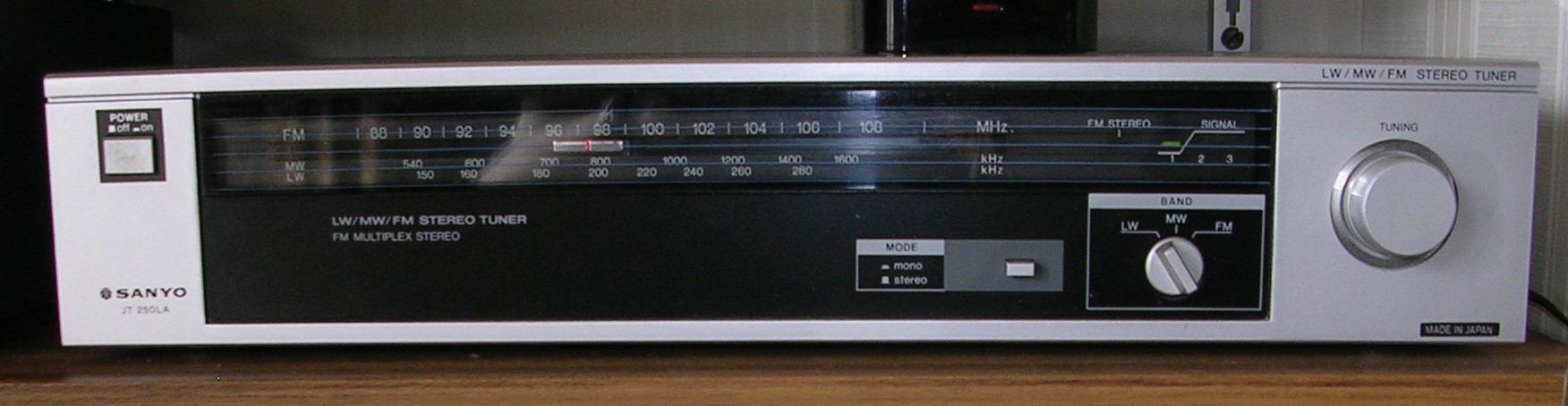
The best part of a hundred years of broadcasting slipped unceremoniously into history at 1:00am on Saturday 27th. September 2026 with the end of Long Wave broadcasting by the BBC.
Click the player above to hear the last few minutes of BBC Radio4 on longwave. I made the (digital) recording from a Sanyo music centre receiver dating from the early 1970's. It has a long ferrite rod antenna and now that the broadband in my area comes by overhead optical fibre, rather than by overhead copper wire, the reception, though not 'crystal clear' was very good.
My personal background experience.
I grew up with a spot on the radio dial being marked as 'Droitwich', BBC Light Programme, Radio 4, 1500m, 200kc/s, 200kHz, 198kHz... it varied with the era. The signal was always strong, there was no fading (and it could be heard far and wide in western Europe and out at sea.)
If my 'ham' radios are able tune to 200kHz they struggle to receive anything without help. (My first ones were not.) They are not generally made to cope with 'short' aerials. There is a clue in the wavelength, 1500 metres. Amateur radios are essentially 'short wave' devices and like a 'half the wavelength' antenna.
Domestic radios used to have a socket for an aerial and an earth and were designed to accept 'short' aerials. The aerial was a random length of wire, the longer the better, high was good too. Serious listeners had it strung down the garden, and casual listeners managed with something shorter, even a wire coat hanger. As a schoolboy I clipped a wire to the metal frame of my bed and connected it to my radio's aerial socket. It worked well. Not many people bothered with the 'earth' connection. In mains powered radios its effect was provided by the house wiring.
Everything changed in the 1960s when 'ferrite rod' aerials became available. They only work effectively for receivers and they have to be tuned to the station to be received. Virtually all broadcast receivers (for medium and long wave) now have them built in. They have an added advantage that they are directional and can turned to optimise reception of a particular station. It is better to minimise interference than to maximise signal strength. My Sanyo tuner has one. Strongest reception is broadside to the line of the rod, and the angle is not critical. The shelf it stands on runs roughly E - W. and Droitwich is a small town near to Birmingham, to the North of me here in Bristol. A happy coincidence.
As I put this page together the 198kHz transmitter is still on air, endlessly repeating a tick box list of all the other ways to listen to BBC Radio4. None of these are available if you live in a very remote area and listened to 198kHz. Its pointless, and makes me sad. What a waste of energy! Why prolong the agony?
My Pye PCR2 'Communication Receiver'
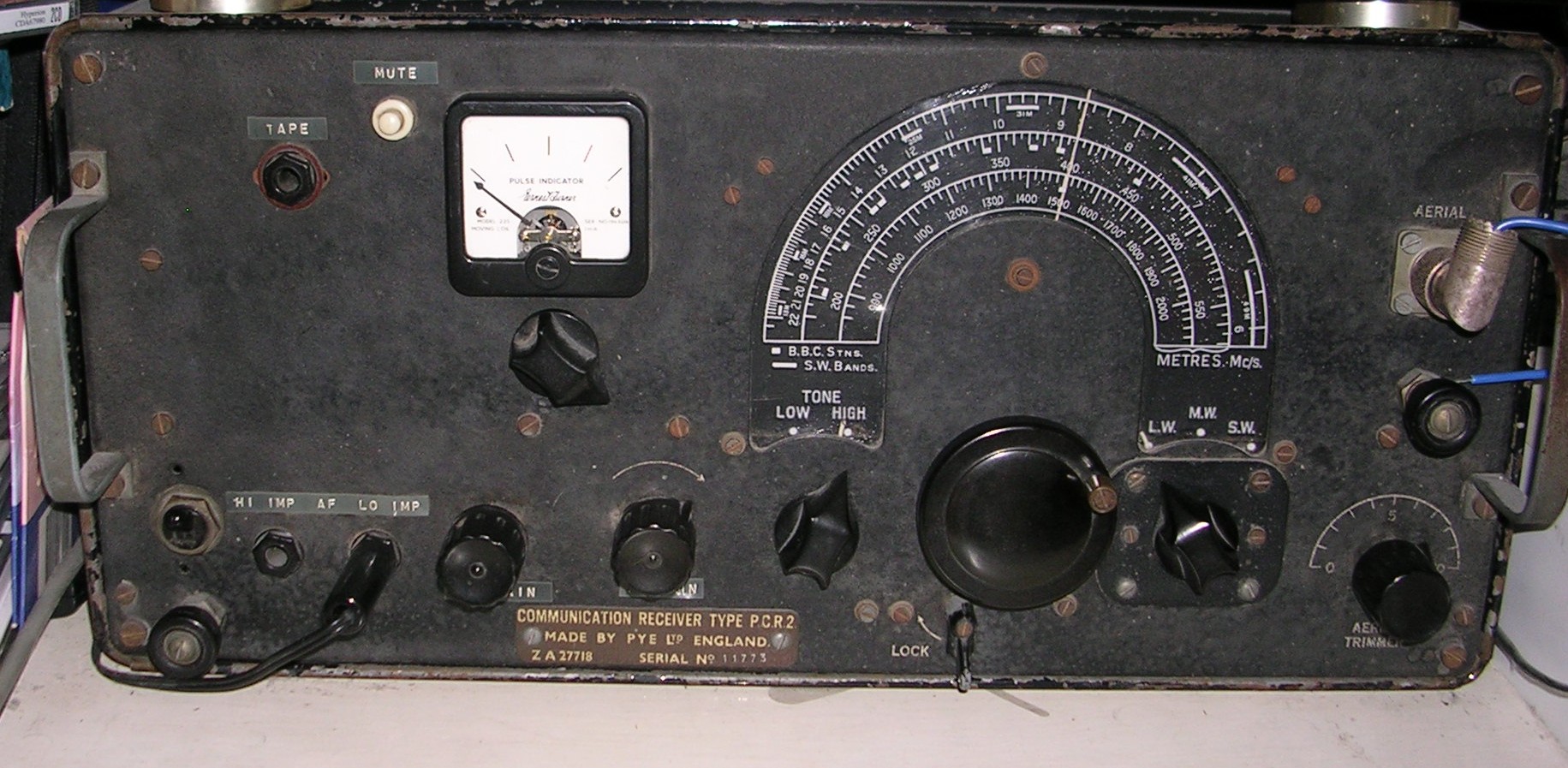
I've had this for about 70 years. It is still going strong after several sessions of re-conditioning. The first was done very soon after I received it. (I must have been a Christmas or birthday present.) It came from a shop in Manchester and was already converted to run from mains power. (I think it was originally powered from batteries and an external separfate unit.)
The rectifier was of the 'metal' variety, and half wave. When it failed, with a charcteristic stink, it took the mains transformer with it. I was still at school when I fitted a new transformer and the then new 'BY100' silicon rectifiers. I also added the 'S' meter, and an RF Gain control. At one time I had a transistorised BFO in it. It ran for many years but about 35 years ago I had to give it a thorough going over and replaced a lot of bypass capacitors that were causing loss of signal and gain.
I intended to record the last 198kHz broadcast digitally from it but got thwarted by a digital software update and the wrong connectors so I settled for a cassette recording. I used a 3m loop of wire from the antenna socket to the ground connection and got reasonably clear reception. There is background noise, probably from my pc and my neighbour.
The line up is the standard RF, Mixer, 2xIF, Diode Detector, Audio Amp, Output. 465kHz IF. Not a true communication receiver but a very good broadcast receiver. It is very stable for its time and, very unusually, covers SW, 22MHz to 5.8MHz in a single range. The tuning is via a very smooth and free chain of thin discs used like gears. The tuning knob has a handle (very necessary!) for rapid large tuning changes and there is a heavy flywheel. You can spin the knob, and also lock it. When I tried receiving SSB (new at that time) my experimental BFO drifted more than the receiver tuning! (The image is reduced by the page rendering, you can 'click' on it for great enlargement. The tuning dial is worth looking at closely.)